
Farewell to the Super Clearing House: A Casualty of Payday Super
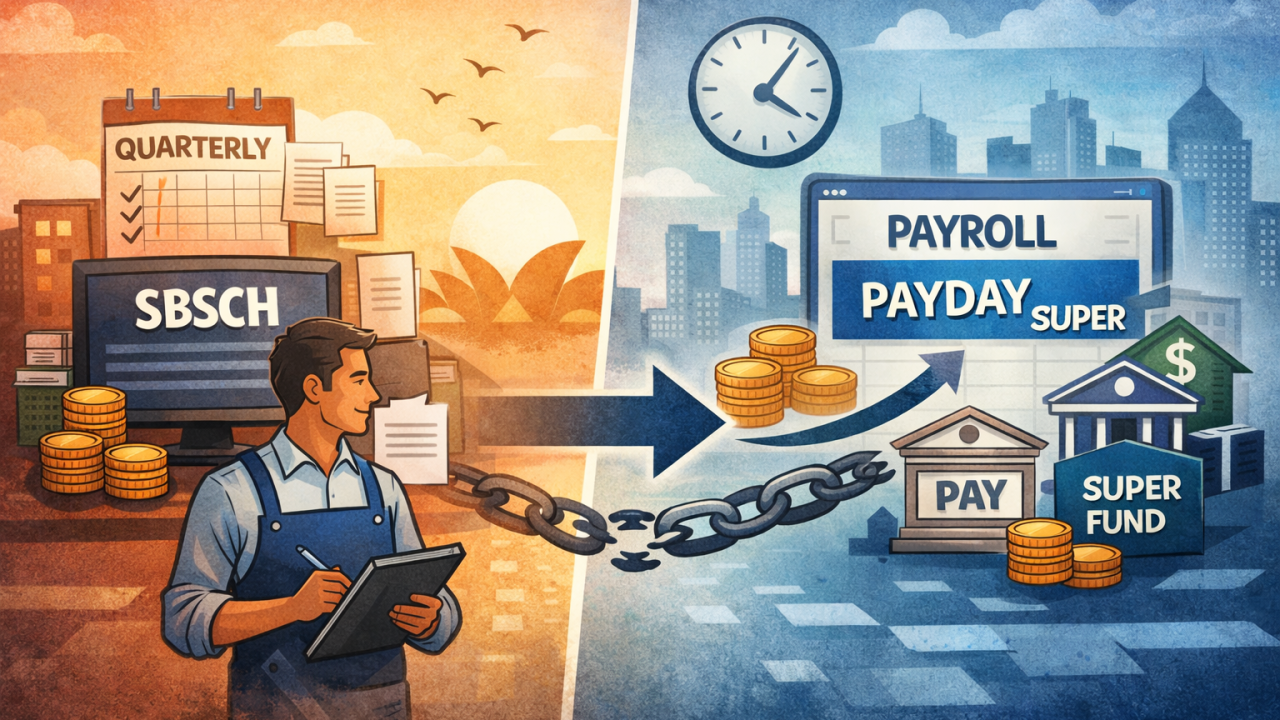
Understanding the SBSCH closure and what Payday Super means for employers
For many small businesses, the ATO’s Small Business Superannuation Clearing House (SBSCH) has been a long-standing part of the Australian superannuation landscape.
It was simple. It was familiar. And it aligned with how superannuation obligations historically worked for small employers.
Now, it is being retired.
Not because it failed — but because the regulatory framework governing superannuation compliance in Australia has fundamentally changed.
What’s changing in superannuation compliance
The Small Business Superannuation Clearing House (SBSCH) was designed around a quarterly superannuation payment model, allowing eligible small employers to make a single payment that was then distributed to employees’ super funds.
That system design matched the superannuation law and compliance expectations at the time.
With the introduction of Payday Super, superannuation is shifting away from periodic, quarterly compliance toward a pay-cycle-based obligation, requiring employers to make superannuation contributions closer to the time wages are paid.
This represents a structural change in how superannuation compliance is expected to operate.
The SBSCH was not built with this model in mind. Its underlying architecture reflects the legislative environment in which it was created, and it does not support real-time or near-real-time payroll-linked processing.
As a result, the SBSCH is being decommissioned rather than re-engineered as part of Australia’s broader superannuation reform agenda.
Key dates for the SBSCH closure
Employers currently using the SBSCH should be aware of the following key dates:
1 October 2025 – SBSCH closes to new registrations
30 June 2026 – Final date for existing users to submit superannuation contributions
1 July 2026 – SBSCH is fully closed
After this date, employers will need to use alternative SuperStream-compliant payroll or clearing house solutions that can support more frequent superannuation payment cycles under Payday Super.
A practical observation on existing payroll processes
Over time, businesses and advisors developed payroll and superannuation processes around the SBSCH — including quarterly workflows, payment timing, and internal compliance checks that aligned with how the system operated.
Those processes were appropriate, compliant, and effective under the rules that applied at the time.
The shift to Payday Super means these established workflows will now need to change. This is not a reflection on past practices, but a direct consequence of updated legislative and regulatory expectations around superannuation timing and payroll integration.
What the SBSCH closure means for employers
The closure of the SBSCH reflects a broader change in how ATO superannuation compliance is expected to operate for employers.
In practical terms, businesses should expect:
Superannuation payments to occur more frequently
Less scope for batching, deferral, or quarterly timing strategies
Greater reliance on payroll systems that integrate super payments
Increased importance of payment timing accuracy and process control
Superannuation is becoming a core, recurring payroll function, rather than a separate, periodic administrative task.
At ZT Partners
At ZT Partners, we see the closure of the SBSCH and the introduction of Payday Super as part of a wider trend toward real-time compliance across payroll, tax, and reporting systems.
Our role is to help clients:
Understand how superannuation reforms affect existing payroll and compliance processes
Adjust payroll systems and cash-flow planning accordingly
Transition to new SuperStream-compliant systems with minimal disruption
Reduce superannuation compliance risk as regulatory expectations evolve
When compliance frameworks change, the biggest challenges often arise from uncertainty and operational readiness, rather than from the rules themselves.
A measured perspective on superannuation reform
The Small Business Superannuation Clearing House served its purpose in the regulatory and operational context it was designed for.
Payday Super represents a fundamentally different compliance model for Australian employers.
Understanding this shift early allows businesses to adapt methodically — rather than reactively — and to plan ahead for the payroll, system, and operational changes that lie ahead.
